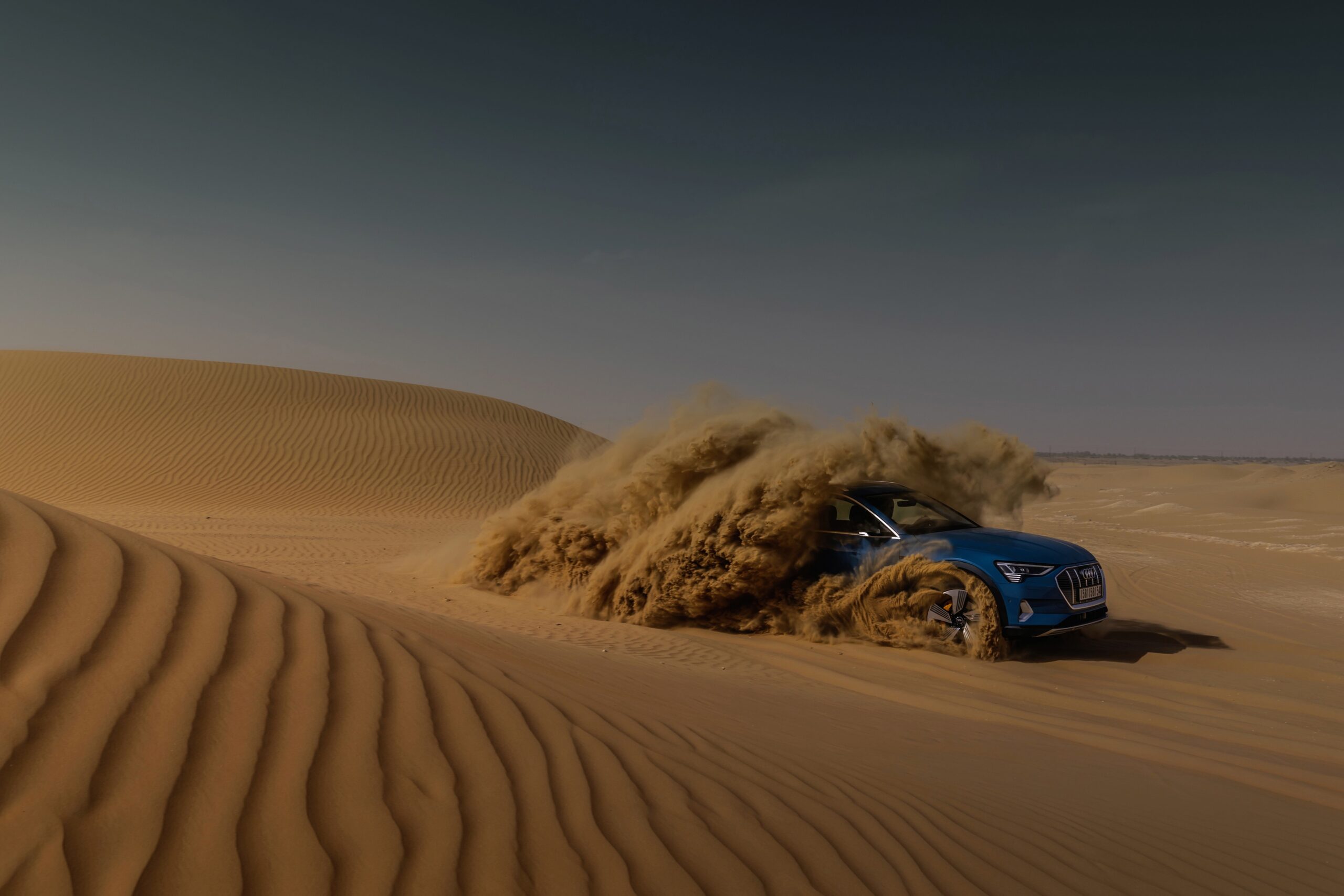
Baking heat shimmers over cracked asphalt, a lone tumbleweed drifts past an endless row of silver sedans. Distant cicadas hum and a faint odor of gasoline hangs in the still air. At first glance, it’s just a quiet desert lot – but by day’s end it reveals an odd legacy of a bygone corporate scandal.
In the desert silence, even the smallest detail feels charged. It reminded me of an old episode of The Twilight Zone (which, it must be said, feels uncomfortably apt here). Miles from city lights, here stand hundreds of luxury cars that never made it back onto the road. It’s curious just how a scheme in a boardroom ends up as silent witness to the Mojave landscape.
Dieselgate’s Desert Legacy
The rows of parked Audis trace back to Volkswagen Group’s 2015 “Dieselgate” scandal. Regulators discovered that VW had secretly installed defeat-device software in about 11 million diesel cars worldwide, including Audis (www.webpronews.com). In the U.S., that revelation triggered a $14.7 billion settlement with owners and authorities. Volkswagen then scrambled to repurchase or fix more than 350,000 affected vehicles (www.npr.org) (www.webpronews.com).
Managing so many vehicles proved a logistical nightmare. Court filings and news reports noted Volkswagen leased vast storage plots for the buyback fleet, picking dry spots in states like California and Nevada to slow corrosion (www.adn.com) (www.npr.org). A Reuters investigation described 37 such sites housing nearly 300,000 cars – everything from a shuttered Detroit stadium to a sun-bleached desert space near Victorville (www.adn.com) (globalnews.ca). Those sites were meant for temporary holding: some Audis would be repaired to meet emissions standards, others dismantled or exported. But many ended up simply parked under the sky, postponed indefinitely.
Some of the numbers are staggering. On the ground, the Mojave lots once held “hundreds of thousands” of VW and Audi vehicles, at a cost of well over $7 billion in U.S. buybacks alone (www.adn.com) (www.npr.org). In total Volkswagen agreed to spend more than $25 billion in the U.S. to buy back up to 500,000 polluting cars (www.adn.com). Those reports alone hint at the scale of waste. One Reuters caption even dubbed one lot a “desert graveyard” of Audis (www.adn.com) – an uneasy image of modern cowboy culture.
Storing the Fallout
Today, the scene looks like an accidental art installation. Pristine windshields crackle in the sun, but paint jobs and rubber gaskets are slowly baking to ruin. A red-tailed hawk circles overhead, indifferent to the rows of high-tech vehicles laid out below. Near one Audi, a pair of rattlesnake boots sit abandoned on the gravel – a stray detail befitting this surreal landscape. Small cacti and desert wildflowers have even begun sprouting between tires, as if nature is amused by the irony.
From a distance, the cars appear uniform – mostly unmodified 2009–2015 Audis, many still with manufacturer stickers and license plates peeled off. Up close, you see the oddity: one diesel sedan’s hood ajar at a jaunty angle, another’s hood rope-knot from a tarp flap. Occasionally a windblown flyer or discarded cup lies forgotten on the fender. Even the soundscape is uncanny – no engines roar, only the buzz of cicadas and a breeze stirring tumbleweeds around silent tire blocks.
Energy analysts and clean-air groups note the brutal irony here. These cars once bragged low NOx emissions, but now their latent pollution risk seeps slowly into fragile desert soil from leaking oil and brake fluid. It’s a useful reminder that technological shortcuts can have unexpected afterlives. A 2018 Reuters photogragh captured similar rows of diesel Audis parked in Victorville, calling it a “sun-bleached desert graveyard” (www.adn.com). And that description still holds: miles of brand-new Audis, baked rather than reborn.
Environmental and Economic Ripples
Of course, Volkswagen insists this isn’t just dumping. As spokeswoman Jeannine Ginivan told Reuters during the recall effort, each desert lot was a transitional measure – the cars are “interim storage,” kept in good condition so they can be “returned to commerce or exported” once U.S. regulators approve fixes (globalnews.ca). The vehicles aren’t supposed to collect dust forever. But after years, many still remain.
That limbo brings mixed impact. For the economy, local businesses did see a bump – towing firms, security guards, even food trucks at staging areas got some work. But then the jobs fade as the project drags on. In one quirky Michigan suburb, even a closed football stadium became a parking garage (VW also used it to stash cars (www.adn.com)). Still, every day those rotting sedans represent billions sunk into idleness. Collectively, the settlement and buybacks cost VW tens of billions worldwide, underlining how dodging clean-air rules can boomerang spectacularly (www.adn.com) (www.webpronews.com).
Environmentally, expert opinions vary. Some claim the soil will absorb the implications slowly but surely, while others note the desert’s aridity far from aquifers limits damage. A Sierra Club volunteer joked (with a sigh) that even the cacti are sarcastic now: “I see all these cars promised to be green, and they’re just leaching oil under my feet. Go figure.” It remains unclear if any truly lasting harm has been done out here; the truth is, the reality is likely more complicated. Wet Desert rattlesnakes hide amid dust clouds, unbothered by corporate misdeeds. Whether months or decades pass, eventually each car hits a fate – fix-up or scrap – and only then will we know the full cost in $ and in soil.
For now, the vehicles’ ultimate fate is an open question. Maybe a portion will be repaired and find buyers, repurposed for new emission standards. Or maybe rising scrap-metal prices will compel a salvage solution. Either way, one thing seems sure: this desert holding pattern has become a modern parable. It shows what happens when technological shortcuts crash into real-world natural limits (an irony not lost on desert rats and ecologists alike).
Voices from the Desert
Passersby and local residents have had strong reactions. “Man… honest to goodness, I never thought I’d see anything like this,” says Jake Robinson, 54, a longtime Palmdale auto mechanic who sometimes drives by the site. He runs a hand over his salt-and-pepper beard. “I’ve been around junkyards since I was a kid, but never a graveyard of Audis like this. It’s eerie to see these shiny cars just baking in the sun. I gotta say, it creeps me out a bit.” His voice trails off as a hawk’s shadow passes over a row of back seats; he shrugs. “It’s just weird, you know? Ends up here instead of cruising the highway. If you had told me a decade ago that VW of all companies would pull a stunt like this, I’d have said you were on something.”
Across the lot, Rachel Greene, 29, who works as an environmental scientist, gazes at the scene with a furrowed brow. She’s not a local – “I came out to see it for myself,” she explains – but from her perspective it’s a stark lesson in waste. “These diesel Audis were sold as clean, efficient cars. Turns out they were anything but. And now look at it: this sweeping monument to a lie,” she says quietly. “Honestly, it makes my skin crawl. We figured out a cheat code for emissions, and then you park the result in nature. It feels like punishment. This kind of mismash is exactly what a lot of us feared.” Yet she also offers a nuance: “At least they didn’t bury them or flood them like some pharaoh’s tomb. VW wanted to repair some and sell when it’s allowed. But I gotta say, right now it looks more like a scrapyard out here, and to me that’s kinda tragic.”
Not everyone is outraged, though most admit surprise. Miles Clark, 37, a freelance photographer who stopped here for a project, chuckles at the absurdity. “It’s like some late-night joke: if Sci-Fi Channel was still around, they’d be airing this as ‘Boneyard 2025.’ The sky’s clear, the cars are clean, and here I am thinking, ‘Wait… am I allowed to take pics of this?’ Honestly, it shows you that sometimes truth is stranger than fiction. But jokes aside, it’s a reminder that when a big company cheats the system, eventually the bill comes due — and nature ends up in the receipt.” He adjusts his camera. “Anyway, I’ve got enough Instagram content for a lifetime of ethical debates.”
As I leave, I reflect on how this scene echoes larger themes. A few decades ago, we talked about dystopian parking lots in sci-fi films; now here it is in high-res. The silence of those cars under the desert sun oddly demands to be heard. Even the older radio hitting ‘80s oldies in a truck somewhere feels out of place. You’d half-expect Krystle Carrington to turn up, calling shotgun over the phone. But no dramatic music cues in real life.
What should readers take from this? Maybe that regulatory enforcement isn’t just legalese — it can shape landscapes, literally. Maybe it’s a wake-up call (or soothing one) for auto companies across the world eyeing shortcuts. Or simply that “there’s no free lunch” resonates: when emissions cheated, the aftermath landed here, not on some spreadsheet. There is value in seeing it firsthand. If nothing else, this autoflage is vivid proof of how trust, technology and tangle of profit and policy can play out far from the boardrooms.
For now, the Mojave rows of Audis wait in their sun-faded hush. No quick fix. No grand answer. It’s up in the air whether they’ll be resurrected on the road or stripped for parts someday. What’s clear is this: once the checkered flag falls on Dieselgate, even the best trick shots eventually meet concrete — or in this case, crushed gravel. The rest, like desert dust, is up to time.
About the Author