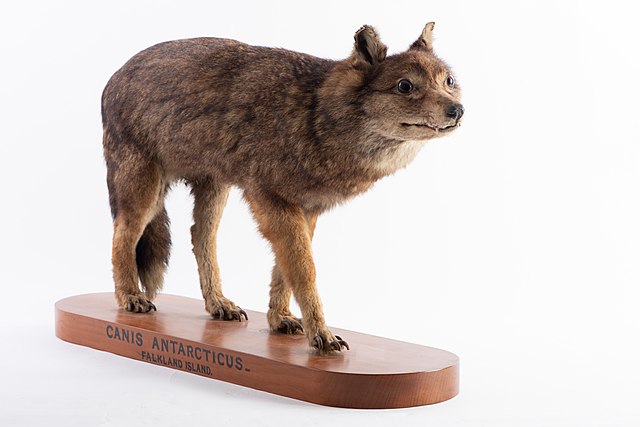
An unusual islandian – The Falkland Islands (Islas Malvinas) are nearly 300 miles off the Argentine coast. When British expeditions first arrived in the late 1600s, they found no humans – but they did find the warrah, the only native land mammal. Charles Darwin encountered the warrah during his 1833 Beagle voyage. Writing in The Voyage of the Beagle, Darwin described it as a “large wolf-like fox” unique to these shores (darwin.thefreelibrary.com). By local report the animal had “no fear of man”: sailors and gauchos frequently lured warrahs with chunks of meat and then easily killed them with knives, illustrating just how tame they were (darwin.thefreelibrary.com). Darwin even recorded a telling anecdote: a warrah once boldly crept into a sailor’s encampment and “actually pull[ed] some meat from beneath the head of a sleeping seaman.” (darwin.thefreelibrary.com)
Darwin worried that the creature’s friendliness was a death sentence. He wrote that within a few years of permanent settlement “in all probability this fox will be classed with the dodo, as an animal which has perished from the face of the earth” (darwin.thefreelibrary.com). His grim prediction came true. By the 1860s, warrahs had been driven from all but the westernmost islands, and the last individuals were gone by 1876 (www.nationalgeographic.com) (abcnews.go.com). A few live warrahs sent to London Zoo in 1868–1870 died within weeks, and only about a dozen museum skins and skeletons survive worldwide (www.nationalgeographic.com).
Settler-era disappearance – Historians say human colonists sealed the warrah’s fate. The new settlers prized sheep farming and also valued the animal’s fur, but were unnerved by any predator on the plains. Sharp-eyed islanders soon blamed the shy canines for livestock losses (even though frightened sheep, not the wolves, were often at fault). In any case, government bounties and poison traps were deployed. Hamley’s team notes that “within about 40 years of regular European settlement, [the warrah] had gone from a thriving animal to one very rapidly hunted to extinction” (abcnews.go.com). With no fear of men – the warrah’s Latin name Dusicyon australis even means “foolish dog of the south” – the trusting creature simply could not flee fast enough (abcnews.go.com) (darwin.thefreelibrary.com).
Lost heritage – Today the warrah is remembered mainly in museums and island lore. It even appears on local coins and place names (for example, West Falkland’s “Warrah River” and a conservation magazine called The Warrah). Its disappearance holds a cautionary lesson: a friendly, insular species can vanish quickly when people arrive. “I’m fascinated by how unafraid this creature was,” says Hamley. Research continues into the warrah’s origins – some scientists now suspect it may have been introduced by ancient canoe-faring peoples – but its end is clear. As Darwin foresaw, the Falklands wolf is now classed with the dodo, a vivid footnote in the history of human-driven extinctions (darwin.thefreelibrary.com) (www.nationalgeographic.com).
Sources: Contemporary reports and recent research synthesize Darwin’s own accounts and new paleontological studies. Darwin’s Beagle journal (1839) records the warrah’s curiosity and his prediction of its fate (darwin.thefreelibrary.com) (darwin.thefreelibrary.com). A 2021 study by Hamley et al. (Science Advances) revisited warrah remains and history (abcnews.go.com) (abcnews.go.com). National Geographic notes that the warrah’s demise (~1876) was the first recorded extinction of a canid (www.nationalgeographic.com).
About the Author