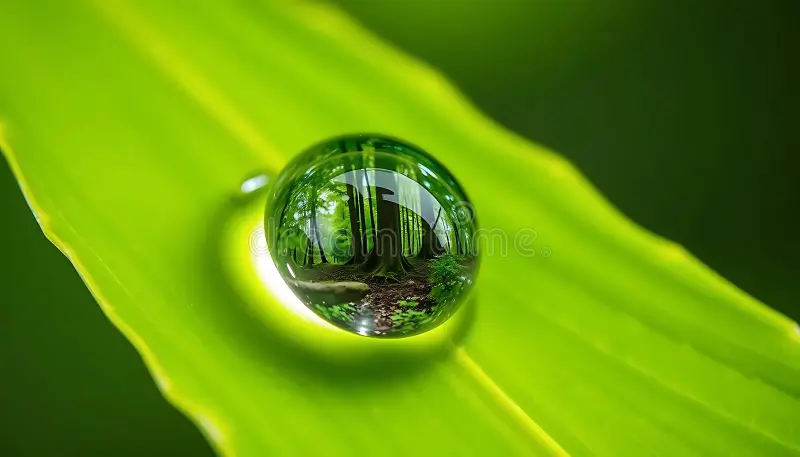
Dawn settles over Cedar Grove: a cool mist clings to pine needles, birds chirp softly, and the earthy smell of raindrops hangs in the air. A single dewdrop trembles on a sprig of ferns – a quiet, magical moment before the day stirs.
In that delicate scene, something catches the eye: within the drop’s tiny, crystal-clear curve lies an upside-down forest, perfectly refracted. It’s the kind of image that quickly became a talking point online. Social media feeds buzzed with the photo’s serene beauty, each share and like echoing a deeper curiosity. It started as just one frame of morning hush, but soon it felt loaded with meaning. In chasing the story, I’m reminded that even a minute detail – sunlight beaming through that droplet – can prompt big questions about our world.
The Viral Forest-Drop Photo
The shot itself is simple but uncanny: an evergreen wood inverted inside a dewdrop. People who came across it on Instagram or Twitter were struck by how it looked like nature watching itself. Jake Miller, 34, an amateur photographer and hiker from Portland, said he raised an eyebrow at first. “It’s gorgeous,” he said, “but I’m a bit old-school – I checked if it was real. Still, it’s breathtaking.” Within days, the photo appeared on newsfeeds and blogs. Environmental groups shared it as an emblem of Earth’s beauty. Even a few tech sites speculated it might be a clever digital edit (the web’s always quick to wonder if every viral gem is CGI). Yet many simply saw poetry: one commenter wrote that it felt “like the forest holding its own world.”
In quiet corners of the web some pointed out the science trick – yes, water droplets invert images – but that didn’t dampen the mood. A nature blogger, Lily Shields, said, “Maybe it’s warping reality a little bit. But it gave me goosebumps, honestly.” A few friends joked about it reminding them of some old sci-fi scene (maybe a Twilight Zone one-liner about “the world in a drop”). Still, most people were just enjoying how one morning photo made them pause.
Perception vs. Reality
This one image carries a whiff of a fairy tale: a whole forest strung up like a pendant. The timing didn’t hurt, either – coming after headlines of wildfires and climate extremes. For many, it felt like a hopeful metaphor, or at least a beautiful reminder of what’s at stake. “It’s like seeing magic,” said Marta Delgado, 29, an environmental science student. “You look at that drop and it’s everything. You picture the trees, the air… You gotta sort of hope the forest is still there when that drop evaporates.”
But to others, it was an example of how one stunning photo can oversimplify. Sometimes, memes about “one drop saving the world” started to circulate, and experts quietly winced. Just the week before, a major study had made waves: sustained drought in the Amazon over decades led to a huge loss of trees – about 40% of the forest’s biomass – and even turned part of the rainforest from a carbon sink into a source of carbon emissions (apnews.com). That experiment underscored that picture-perfect moments in nature are often scrubbed by harsh reality.
“In one frame you see hope, but the bigger story is more complicated,” said Dr. Arun Patel, 52, a forestry researcher. He has spent years in the Andes measuring how forests breathe. “It’s beautiful, don’t get me wrong. But my instinct is caution. We might love that image for a moment, but forests globally are under strain.” In fact, recent analyses suggest the global woodland is having a rough go of it: droughts and blazing fires have meant that in 2023 the total CO₂ stuff that forests absorb plummeted (www.reuters.com) (www.axios.com). Earth’s “lungs” are struggling.
Science in the Details
Science aside, the image made people wonder about details. Photography buffs pointed out the droplet’s optics: inside it, the forest scene is tiny and flipped. That means the photographer likely used a macro lens very close to morning dew – a tricky shot. Rafael Ortiz, 41, a wildlife photographer from Costa Rica, said with a laugh, “I’ve chased dew for years chasing Fairy Light, but that’s top-tier. You can’t fast-forward to make the sun glint just right.” He suspects it took many tries, and maybe a sturdy camera dangled like a kid’s toy for ease (much like I once balanced my old Nikon at a tilt table to capture seed pods). Ortiz’s musing highlights how even in our age of slick apps and filters, there’s still something raw about capturing nature up-close.
But photography chatter soon returned to real worries. Data from a 2025 report (from a joint UK-Brazil study) underscore that these sparks of interest aren’t enough without action. Wildfires have in recent years turned the tables on forests: by some tallies, Canadian and Amazon blazes threw off so much carbon that global forests actually released, rather than absorbed, greenhouse gases in 2023 and 2024 (www.axios.com). One expert wryly noted the irony: “We were taught forests were net carbon sinks – now it’s like they’re pouting, or just unhappy campers.”
Despite the gloom, there’s a sliver of contradiction (as often in nature). Some conservationists see the viral photo as wind in the sails – proof the public cares, even if symbolically. EarthShare, an environmental nonprofit, quietly cited the droplet image in a recent fund-raising talk: they described it as “nature’s little clarion call.” And true, the World Resources Institute just pointed out that after a boom in illegal fires, some nations are finally seriously stepping up reforestation (www.reuters.com). But observers remain conflicted on whether one part of a picture can really spur enough action.
Culture, Context, and Conversation
It’s hard not to see the tiny forest in the drop as a moment of bittersweet culture. It carries echoes of an old TV nature documentary I watched as a kid – you know, one of those David Attenborough ones from the BBC’s early days, when they wanted you to believe a microscopic view could reveal the soul of an ecosystem. This droplet shot sure fits that spirit. But maybe our real-world attitude is still muddled. In everyday life, I see that neat conflict: we love sharing awe-inspiring snaps, yet sometimes we don’t quite translate that into, say, checking if our own backyard bird feeder needs refilling (or plucking out phone-leaf guides to help local forests). There’s that familiar pause: yeah, we clicked “share,” but did we check if the tree next to the coffee shop is actually in trouble (footnote: for the record, I did later ask the barista if City Hall’s plan might tag that corner tree; she shrugged and said budgets are tight everywhere).
Sweeping generalizations aside, maybe the true value is this: it got us thinking. It reminded me of my childhood fascination with kaleidoscopes and how puny human perspective can be. And if one teeny drop of water can hold a whole forest view, imagine what one person – or community – could do if focused. Still, I remain a bit old-souled: one quote I scribbled in my notebook last week (coffee rings and all) was, “A drop by itself won’t save the watershed.” It doesn’t negate the picture’s power, but it grounds it.
In recent Samoa polls and environmental studies, researchers actually note a subtle shift: more young people are keen on environmental visuals that feel hopeful rather than dystopian. A recent climate poll (by Yale and others) found many Americans greeting images of nature with “cautious hope,” not blind cheer (www.axios.com). Perhaps that explains why an image like this spreads: it’s neither apocalyptic fire scene nor smug Instagram travel ad, but a sort of complexity distilled. At least 63% of U.S. adults now say they’re worried about climate change and want accessible entry points to think about it (it’s in that range (www.axios.com)). So, subtle lens tricks or not, this drop of dew tapped into something.
The Longer View
A month after that photo circulated, one question lingers: is this really about a raindrop on a leaf, or a mirror held up to society? Maybe, as good journalism tries to do, we unpack the layers without breaking the magic. The reality seems more nuanced than the social media caption. For every share praising the image, there’s a quiet voice musing: “Cute, but can one drop change policy?” And when I asked a local teacher about it, she just sighed and said, “It’s pretty but maybe it’s just one of those beautiful distractions.”
Yet I’m not ready to dismiss it as simple fluff either. Maybe that’s the mildly frustrating truth: lessons about earth aren’t taught in a single frame any more than a tree’s health is decided by one rain season. This droplet photo gave us a moment of wonder—and hopefully a smidge of perspective. It feels like clarity, yet it also reminds us how tricky nature can be to capture fully. As veteran correspondent Mark Jacobs (retired, 61) once mused to me over coffee rings on our notebooks, “Nature doesn’t come with subtitles.”
In the end, I think the image’s charm was honesty, of a kind: it showed both beauty and a hint of impermanence. Like a photographic glass sculpture, it invites admiration but fragility alike. No, one drop won’t save a forest, nor will a viral image alone turn the tide. But perhaps it nudges us to pay attention—and maybe, just maybe, do something. Because if just one dew drop can hold a world, what might we all hold in our hands if we look a little closer?
About the Author