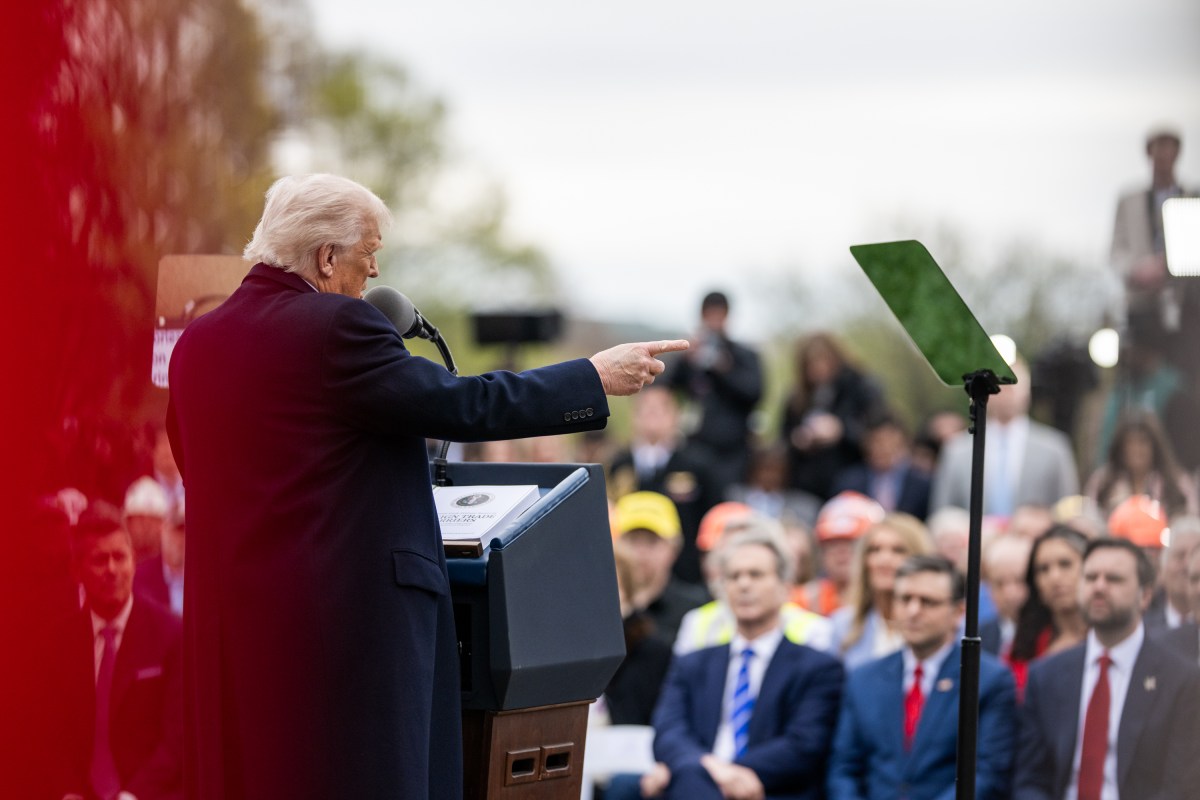
The faint scent of gasoline hung in the air outside the Rose Garden, while a coffee ring marred the White House communications director’s notepad. A lawnmower hummed somewhere down Pennsylvania Avenue.
That small, domestic tableau has stuck with me. It felt like a stage set for a policy meant to rewire global markets — and yet it opened with a neighborly, almost ordinary smell. You could almost believe the government’s pitch: bring jobs home, stop the deficit, make the supply chain American again. But the math is less sentimental.
What the study finds
On April 2, 2025, President Trump used that setting to declare what he called “Liberation Day,” unveiling a sweeping tariff program intended to shrink the U.S. trade deficit and revive domestic industry. The packages included a baseline levy and higher, country-specific reciprocal rates aimed at nations with large surpluses with the United States. The announcement rattled markets and set off a chain of policy responses and legal challenges. (cnn.com)
A team of economists led by Ina Simonovska (University of California–Davis) has now run those tariff numbers through a global, input-output trade model and reached a blunt conclusion: if other countries hit back in the way the model calls “optimal retaliation,” U.S. welfare falls — materially. The calibrated results show U.S. welfare could drop by as much as 3.8 percent once retaliation and the tangled web of global supply chains are taken into account. The same analysis finds global employment would contract by roughly 1.1 percent. (nber.org, eurekalert.org)
That 3.8 percent is not a guess about a single sector. It folds in price changes, lost variety of imported goods, tariff revenues (and how those revenues might be used), and the knock-on effects when inputs — the parts that make other parts — become more expensive or harder to source.
Why retaliation matters
Tariffs aren’t a one-way tax. They change incentives across the world. If the rest of the world does nothing, the U.S. can, in theory, gain from improved terms of trade and the revenue raised — especially if that revenue is reallocated in ways that offset other taxes. The study even calculates a theoretically “optimal” unilateral U.S. tariff of about 19 percent, applied uniformly, which differs sharply from the administration’s patchwork of bilateral rates. But the model’s realism comes from what it assumes next: other countries won’t sit still. When trading partners impose counter-tariffs targeted to inflict maximum pain back on the United States (call it optimal retaliation), the paper’s gains evaporate and turn into persistent welfare losses. (nber.org)
Real-world numbers back up the scale of the effect. Work by Yale’s Budget Lab shows that the April measures pushed the U.S. average effective tariff rate to levels not seen in decades and estimated short-run consumer price effects in the low single digits — enough to shave thousands of dollars of purchasing power from the average household in a year if the Fed didn’t move. Those shifts matter for a middle-class family deciding whether to buy a used car or fix the current one. (budgetlab.yale.edu)
Voices on Main Street
“The steel coming in got more expensive overnight, and I’m not a numbers guy, but I saw our margins evaporate,” said Maria Alvarez, 52, owner of a metal-fabrication shop in Dallas. “We’re trying to hire, but we can’t promise raises when bolts and bearings cost more. I mean, I get the idea — I do — but it’s scary. Real scary.” Her hands trembled slightly as she spoke; there was a worn golf glove draped over the back of a chair behind her — a detail that felt small and human amid the statistics.
“I gotta say, I thought maybe the tariffs would bring back the plant where I used to work,” offered Thomas Reed, 34, a laid-off auto-parts assembler in Toledo. “But folks around here say prices went up and orders went down. So, yeah — not exactly the miracle pitch they had on TV.” He chewed his words like someone tasting something sour.
Politics, policy and a messy calculus
There’s a political logic that’s hard to ignore. Protectionist measures have long been used to signal muscle and to court voters in manufacturing regions left behind by globalization. Some Treasury and trade officials argued for calibrated tariffs that target specific non-tariff barriers rather than blanket rates. Meanwhile, legal challenges and a chorus of business groups and some allied governments painted the policy as overreach, pointing out that the president used emergency authorities that are traditionally for wartime or acute crises.
Analysis from think tanks and policy shops — CSIS, for example — shows the pain is uneven: certain sectors like metals, electronics components, and clothing face the biggest price jumps, while others may see smaller effects. Firms that rely on imported inputs end up paying twice: once for the higher-priced imports and again through lost foreign demand if retaliation hits U.S. exporters. That double hit is a key channel driving the welfare losses the study finds. (csis.org, budgetlab.yale.edu)
An open question (and one mild contradiction)
Not every model paints the same picture with the same magnitude. Some frameworks suggest modest, targeted tariffs can be welfare-improving under narrow assumptions about pass-through and firm behavior. The authors here stress that the outcome hinges on how retaliation is structured, how tariffs are spent, and how quickly firms can reconfigure supply chains. Sources remain conflicted about how durable those supply‑chain shifts will be. It remains unclear whether companies will relocate manufacturing en masse or simply reroute purchases to other low‑cost countries. The reality is likely more complicated.
A brief detour — an unexpected detail
I once watched an older union rep at a community forum point to a spreadsheet marked in pencil, sighed, and muttered, “Feels like ‘All in the Family’ politics — loud, proud, and nobody’s listening.” That line stuck with me because the tariff debate often packs a lot of moral theater into a very technical problem.
What this means for readers
If you buy imports — which, in modern America, is almost everybody — tariffs are not an abstract tax on “foreign stuff.” They show up in fewer choices, higher prices, and slower job growth in connected industries. The study’s headline number — up to a 3.8 percent decline in U.S. welfare under optimal retaliation — is a blunt way of saying: expect measurable, persistent hits to living standards if this spirals into a sustained global tit-for-tat. That’s the takeaway for voters and policymakers who care about workers, not just headlines.
One small, personal note
I remember covering a trade dispute in the 1990s and climbing into a pickup to drive through a shuttered mill town. Inside the cab was a cassette tape of classic rock that someone had left on the dash — that little artifact of a different era felt oddly similar to the coffee ring and worn glove I mention above. Context matters. Numbers matter. People matter.
There’s room for targeted reforms. Tariffs are blunt instruments, and the study suggests a clearer, more surgical approach — or cooperative multilateral solutions — would be less costly. But action must be guided by realism: if your plan counts on trading partners doing nothing, your plan is fragile.
For now, the central question for policymakers is this: are the political gains worth the economic pain if retaliation follows? The study makes a persuasive case that the answer, for the U.S. economy as a whole, is probably no. (nber.org, budgetlab.yale.edu)
— James H. Carter, contributing columnist. I still can’t get over that coffee ring.
Sources and further reading: The Journal of International Economics paper “Making America Great Again? The Economic Impacts of Liberation Day Tariffs” and the NBER working paper recasting the same results; analysis on tariff incidence and consumer effects from the Yale Budget Lab; commentary and sectoral breakdowns from CSIS. (nber.org, budgetlab.yale.edu, csis.org)
About the Author