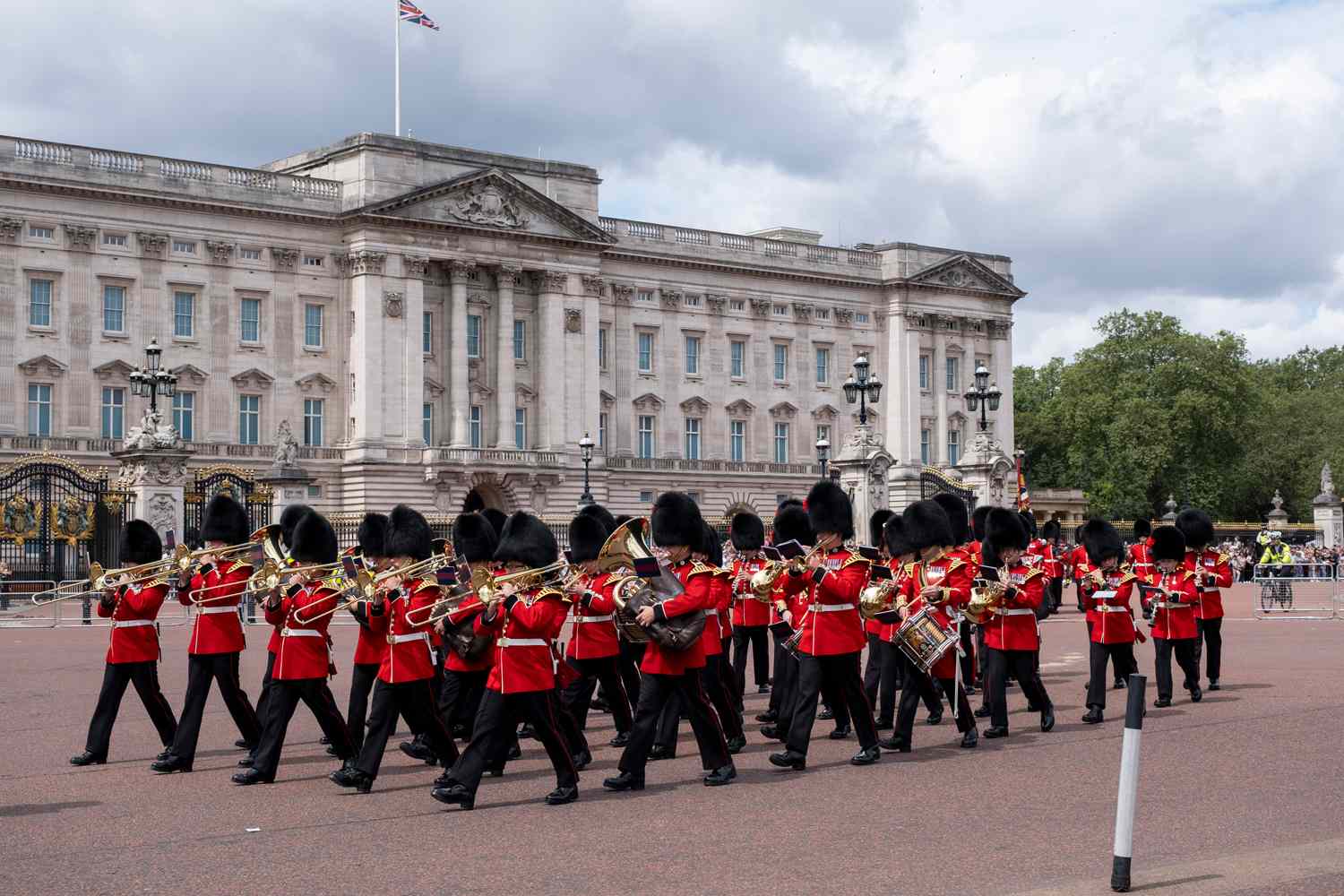
Sun warmed the grey cobbles as a solitary pigeon fluttered by. The snap of a bass drum gave way to a heavy guitar riff—incongruous at Buckingham’s ceremonial morning. In that heartbeat, tradition and rock collided: tourists blinked as the Guards’ brass rang out recognizable chords.
It was a surreal moment on a bright London day. Onlookers realized the band wasn’t playing “God Save the Queen,” but Black Sabbath’s “Paranoid.” Word quickly spread that, three days after Ozzy Osbourne’s death, the Coldstream Guards (in full bearskin hats and scarlet tunics) had played the heavy-metal classic during the Changing of the Guard. Before long a video of the performance was circulating online.
Royal Guard’s Unlikely Tribute
For many, it felt like witnessing an alternate history. The Coldstream Guards, one of Britain’s most storied military bands, usually stick to marches and classical pieces. Their music has even ranged from Beatles tunes to movie themes—TIME noted the Guards once covered the Game of Thrones theme (time.com)—but a Black Sabbath riff at Buckingham had never been on the playlist. Still, the clip was unmistakable. Viewers saw uniformed musicians outside the palace gates nailing the song’s opening bars, the notes echoing off historic stone.
The timing was deeply symbolic. Ozzy Osbourne, Birmingham-born frontman of Black Sabbath, had died days earlier at 76, capped by a farewell concert in his hometown (www.reuters.com). Buckingham Palace’s traditional changing ceremony was far from Birmingham’s streets of mourners. Yet here was Britain’s ceremonial core quietly nodding to one of its most eccentric sons. The act seemed both poignant and playful. As one fan-size Sergeant might have thought, the King’s men had gone “full Sabbath” in service of a mosh-loving legend.
Ozzy’s Legacy in Britain
Osbourne’s life bridged the gap between working-class culture and the establishment in unexpected ways. Rising to fame in the 1970s with hits like “Paranoid” and “War Pigs,” he became known as the “Prince of Darkness” in heavy metal, redefining rock. (www.reuters.com) Yet the same man who once famously bit a bat onstage also played for the royal family: at 2002’s Golden Jubilee concert he performed Paranoid for Queen Elizabeth and Prince Charles (metalinjection.net). The anniversary show hinted that even Britain’s establishment could embrace a wild riff.
That duality helped Osbourne become a national figure. In life he sold over 100 million records worldwide, then reinvented himself as a TV star on The Osbournes. Major media noted the outpouring of love after his death: punk was praised left and right, with Dolly Parton calling him “a legend” and Elton John calling him “the king” of rock (apnews.com). In that context, a Guards band blurring tradition and metal feels almost inevitable. It underscores how far Osbourne’s influence reached – from grimy local halls to glossy palace grounds.
Social Buzz and Skepticism
Once the video hit social media, reactions poured in. Some viewers cheered, tweeting clips with hashtags like #PrinceOfDarknessMeetsPalace, marveling at the quirky salute. “That was wild,” says Trevor Fitzpatrick, 55, a retired music teacher who watched a recording of the ceremony on his phone. “I mean, I gotta say, hearing those riffs at Buckingham felt like something out of a dream. I had to double-check it wasn’t a prank video.” His half-laughing tone captured the general amazement: retiree who once drilled students in Bach suddenly nodding to Sabbath.
Others were more guarded. A few commenters wondered if the clip was staged or edited. Buckingham Palace itself offered no confirmation, and palace officials have stayed uncharacteristically silent. Some on Twitter noted that there’s no official palace playlist announcement mentioning Ozzy – leaving room for doubt about whether the tribute was formally approved or just a spirited interlude. (Yes, one cheeky fan even quipped that perhaps the palace has a secret death-metal division – a fanciful notion, which seems a stretch, frankly.) Another viewer cautioned friends not to forward the video as gospel truth, recalling how easily viral clips can mislead. Indeed, major fact-checkers often remind readers that even customized videos can take off as memes. It’s still unclear how the tribute came together, and some sources note it may never be fully confirmed.
Tradition Meets Pop Culture
This unlikely mash-up of ceremony and rock isn’t entirely without precedent. As TIME reported, the arrogant tradition of those ceremonies has sometimes made way for pop culture: in 2014 the same Guards band performed the Game of Thrones theme at Buckingham (time.com). The palace’s own website even notes that Changing of the Guard music “can include a variety of tunes, ranging from traditional marches to songs from films, musicals, and even familiar pop songs” (time.com). In other words, Britain’s brass was always allowed to mix old with new, high and low.
Still, seeing it happen can feel like a cultural earthquake. It raises questions about how a bunch of statuesque guards became a flash mob tribute. Some observers called it heartwarming – proof that Ozzy Osbourne’s message transcends boundaries – while others wondered if it was a jokingly-coordinated spectacle. In a sense, the scene captures how confusing and interconnected media have become: a casual tourist video quickly turns into international news, swirling fact and fandom. In my own travel-worn notebook (I once scribbled about the absurdity of kings jamming out), I’d note that the rehearsal of tradition for viral clicks seems odd, but maybe it’s just the world now.
At stake is how people connect with icons. This act of homage – planned surprise or not – certainly bolstered Osbourne’s nearly unrivaled status. Harriet Clarke, 33, a Briton boarding a tour bus with her family, said she was “totally gobsmacked. It sounded like Paranoid, and I just had to laugh. I mean, live by the metal, right?” Her broad grin hinted at pride more than irony. Many in Britain are devout fans of both the royal pageantry and the rock god; for them, the image of bearskins and electric guitar is strangely fitting.
Metallic Aftermath
Whatever one makes of the Coldstream Guards’ performance, the clip has a lesson: it shows how flexible (and viral) traditions can be. Classic ceremonies aren’t immutable relics – they can pause for a headbanging riff when the moment demands. As one veteran tour guide pointed out to me with a wry smile, “Hey, if Big Ben tolled to ‘Highway to Hell,’ I’d hardly be surprised these days.” It’s a minor ripple in the grand scheme, but a telling one. In tributes now, country and pop culture bleed together, and even Buckingham Palace isn’t immune.
For readers, that means a chance to see beyond sheer novelty. The piece puts this video in context: it wasn’t just a random joke, but part of a wider wave of reactions to Osbourne’s death. It reminds us (nudge, wink) to think critically about viral moments: mixed reports and silence suggest it might be more spectacle than ceremony. And it highlights an odd cultural quirk: a lifelong metal rebel turned national icon, now honored by the Queen’s own guards. You walk away understanding not only that this happened, but why – and why you might have doubted it.
Image prompt: A photorealistic scene at Buckingham Palace during the changing of the guard, sunny midday light. The Coldstream Guards stand in bright red tunics and grand black bearskin hats, mid-performance, some holding brass instruments up (tubas, trumpets). One musician in the front waves a conductor’s baton while others play gleaming brass. In the background, the palace facade is bathed in golden light. The mood is curious and surreal. Include subtle humor: a few stunned tourists (diverse ages) pointing cameras, some looking delighted and perplexed. The style is crisp, documentary-photo realism, capturing the contrast of formal uniforms and the unexpected “rock concert” vibe, with warm sunlight and slight lens flare. The composition shows the band in semi-circle near the palace gates, audience in front, and clear musical energy in the air.
About the Author