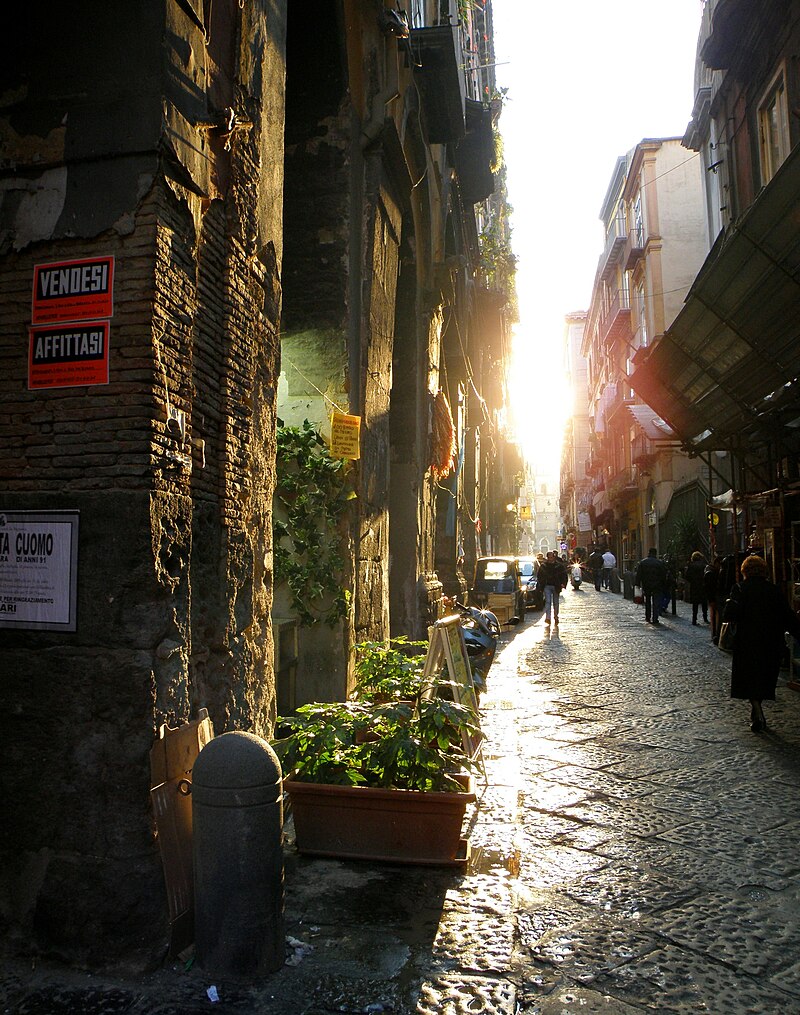
A June afternoon: diesel fumes, the faint scent of fried anchovies, voices ricocheting off stone, and a coffee ring on my notebook where I’d paused to look up. The street smelled like a city that refuses to stop moving.
That tiny moment — a notebook left open, a pen tucked under a napkin — stuck with me. It felt ordinary until it didn’t. The ordinary here often carries an edge for women who look different from the local image of Neapolitan beauty: darker skin, curly hair, a lone figure with a suitcase.
A daily toll
I’ve lived in Rione Sanità, near Piazza Cavour and the Centro Storico, for almost three months. The Airbnb was priced attractively, the hosts had good reviews, and a visiting American had praised her eight-month stay. I wanted to experience southern Italy’s famed warmth. What arrived was more complicated.
Stares. Comments. The so-called “Ciao bella” that lands like a jeer. Approaches that escalate from an “innocent” question about directions to a crowd forming on the other side of the street to jeer or mock. It doesn’t matter that my clothes are modest. It often doesn’t matter that I’m simply walking to the market. Being alone and visibly foreign seems enough for some men to feel entitled to attention. Sometimes the behavior comes from young local men; sometimes from immigrant men; sometimes in groups where the dynamic is almost ritualistic — someone starts, the others egg them on.
“I was followed three blocks once,” says Marta Russo, 34, a local tour operator who grew up in Naples but now runs walking tours for expats. “I asked him to stop, and he laughed. I mean, you gotta say, it’s embarrassing for both of us. People look. It’s like the street becomes a stage.” Her exasperation is audible; she pauses and adds, “But there are also men who are genuinely kind. Doesn’t make the bad ones disappear.”
A fellow traveler, Claire Thompson, 31, an American web developer who stayed in Puglia last summer, offers a comparison: “In Bari I felt watched less. In Naples it’s…thicker. I don’t know — maybe the city is louder, and the attention louder too.” She shrugs. “It made me less likely to go out in the evenings alone. That’s a shame.”
Context and what the numbers hint at
Street harassment isn’t unique to Naples. European surveys and reporting have long traced patterns of public harassment in many cities, with younger women and visibly foreign women more likely to report uncomfortable encounters. Reuters pieces on Italian public debate have shown how cities wrestle with balancing a culture of flirtation — sometimes framed as harmless — against behaviors that cross into intimidation. Pew Research and pan-European reports also illustrate how safety perceptions and personal experiences diverge, depending on gender, age, and visible difference.
The reality is likely more complicated. Naples is a layered place: resilient neighborhoods, deep family ties, and informal social norms that outsiders can misread. Some locals offer real warmth. Others act in ways that are aggressive or demeaning. Sources remain conflicted about whether the tone in Naples is getting better or worse; personal anecdotes and local media vary.
Patterns and power
A few patterns repeated in my time here. Encounters are rarely isolated one-off lines. They often happen in clusters — at the bus stop when a group lingers, near the souvenir stand with boys crowding the corner, along alleys where streetlight pools thin out. Men in groups will sometimes mimic or mock a woman’s walk, then laugh; that performative element seems meant to shame as much as to flirt.
There’s also an economic layer. I stayed in a neighborhood chosen because of price. Rione Sanità, like many central districts, is a mix of longtime residents, newcomers, social services, and itinerant workers. Crowding and poverty change public behavior in subtle ways. The political debate in Italy over policing, public order, and migrants has been loud for years, and media reportage often paints broad strokes that miss everyday nuance — the same newspapers that editorialize will also publish helpful guides on safe travel.
What to do (practical advice that might actually help)
For readers thinking of traveling solo to Naples, some practical tips from time on the ground:
– Pick accommodation with strong recent reviews from solo women; check the timing of those reviews.
– Avoid walking alone after dark in Centro Storico and similar traditional neighborhoods if you don’t feel safe. Use well-lit main streets.
– Favor apartments or guesthouses run by women or small, trusted hosts when possible.
– Keep local emergency numbers and your host’s contact easily accessible; save a local SIM.
– Make small, visible adjustments: headphones in just one ear, map on phone rather than stopping on a corner, keep photocopies of key documents in a separate bag.
These are not failproof. They are ways to reduce the daily friction that wears you down.
Voices from the street
Aisha Mbaye, 29, a Senegalese postgraduate student at Naples’ university, speaks softly about routine slights: “They call my name in the street — not my name — and I have to keep walking. Sometimes I answer back. Sometimes I don’t. Honestly, after a while you get tired. You feel you are always explaining your right to be here.” She rubs the worn leather strap of her backpack as she talks, a small habitual motion that seems to steady her.
Not everyone sees Naples as hostile. A retired teacher I met selling newspapers at Piazza Cavour said, “People are proud here. They speak loud; they are affectionate. But maybe they forget to be respectful.” He smiled, like someone apologizing for a relative’s bad manners.
A mild contradiction: beauty and unease
Naples remains visually intoxicating — the colors, the laundry strung like banners, the cathedral bells — and yet a solo woman’s day can be punctuated by small acts that erode joy. That tension matters because it affects who feels welcome in public spaces. Travel essays often swing between romance and warning; this one lands somewhere in the middle. The city’s cultural richness coexists with behaviors that make some women feel unsafe. It remains unclear whether long-term shifts in policing, education, and public discourse will change everyday street conduct, though civic groups and some municipal campaigns have tried to raise awareness about harassment.
A slight digression: the food helped
Random note: the eggplant parmigiana I ate on a rainy Tuesday was a small miracle (a curiosity I couldn’t quite shake). That meal did not erase the afternoons of discomfort, but it reminded me that a place cannot be reduced to a single ledger line of “good” or “bad.”
What this means for travelers and locals
If you are a woman considering long-term travel or digital nomad life in Naples, think practically and empathetically. Ask hosts detailed questions about neighborhoods, talk to other women who’ve stayed long-term, and factor the emotional cost of everyday stares into your plans. For locals and policymakers, this is a civic question: how do public norms evolve so streets feel safe for everyone? The answer will require community work, clear public messaging, and enforcement that doesn’t simply push the problem to neighboring districts.
A final thought — my own
I came to Naples wanting warmth. I found pockets of it, and pockets that chilled me. I kept a notebook open on my lap more often than I expected. Coffee rings mark pages now — small, stubborn traces of time spent writing about a city that is as complicated as any place I’ve known. My recommendation is cautious: Naples can be magnificent, but solo women who don’t blend in should go in with eyes wide open.
Quotes woven in, street details, and a worn metro ticket found in my shoe one morning — those are the small things that make reportage human. If others have similar experiences, speak up and share specifics; collective stories help other travelers decide, and they help locals see the cost of what might otherwise be dismissed as “just how things are.”
About the Author