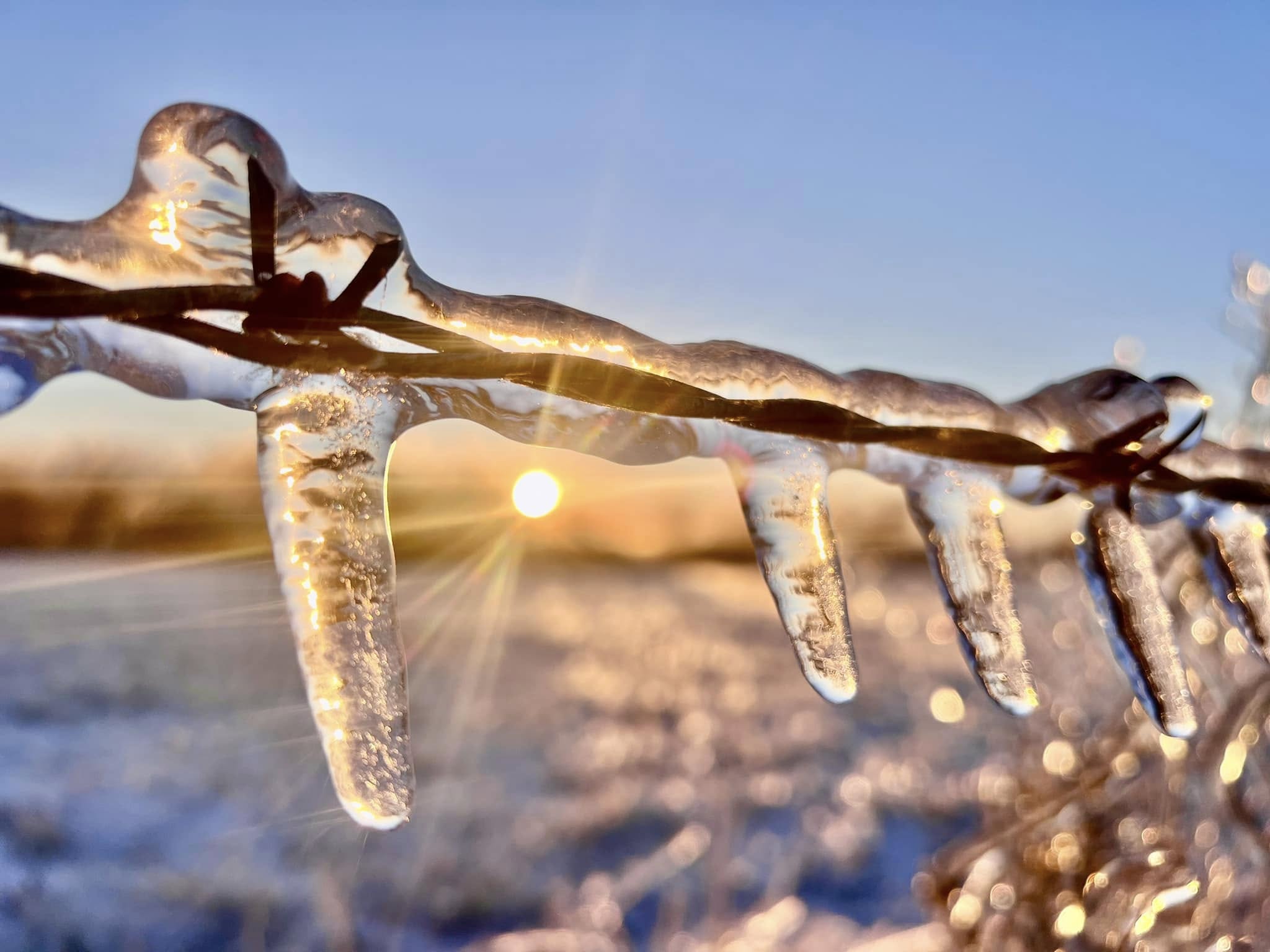
Have you ever walked past a wire fence on a frosty morning and noticed the intricate lace-like patterns of ice clinging to its metal strands? It’s a sight that’s both commonplace and captivating, often stopping passersby in their tracks. But what’s happening here, and why does nature decide to show off its artistic side on something as mundane as a fence? Let’s dive into the science and beauty behind these frozen masterpieces.
The Science Behind Ice Patterns
At its core, the creation of ice patterns on wire fences is a wonderful interplay of physics, weather conditions, and surface chemistry. When the air is cold enough for frost formation, atmospheric moisture undergoes deposition, transforming directly from gas to solid on sub-freezing surfaces. Wire fences, with their expansive and exposed surfaces, are perfect canvases for this transformation.
But why do these patterns emerge in such intricate formations? It all boils down to how water vapor freezes. Ice will first form around nucleation sites—small imperfections or debris on the wire—that serve as the starter for crystal growth. The metal wire acts as a heat conductor, quickly cooling the nearby air and allowing more moisture to freeze. As these crystals grow outward, they encounter variations in temperature and moisture availability, which dictate the eventual shapes and patterns.
Weather’s Artistry
Weather conditions play a melodious role in the design and prevalence of these ice patterns. Factors like wind speed, humidity, and temperature gradients all tweak the resulting ice artwork. For instance, a gentle and steady breeze ensures even distribution of moisture, often resulting in more symmetrical and refined patterns. Conversely, turbulent air movements can lead to more chaotic and less uniform formations.
If you look closely at these patterns, you might notice similarities to those found in nature, such as the branching of a tree or the delicate veins of a leaf. This is an expression of a concept called “fractals”—a repeating pattern that displays at every scale and is a recurring theme in nature, from river networks to snowflakes.
Historical and Cultural Context
Our fascination with ice patterns isn’t new. Historical literature and art have often referenced such natural phenomena, tying them to seasonal changes and even folklore. In some cultures, the formation of these ice patterns was interpreted as a sign of impending weather shifts—a natural barometer of sorts.
Exploring cultural interpretations of frost reveals another layer of meaning. In Finnish mythology, for instance, frost was personified by a deity named Pakkanen, reflecting the cultural respect for the natural world’s mysterious and powerful beauty.
Practical Implications
While they might seem merely decorative, these ice patterns can have real-world implications. Understanding the conditions that lead to their formation helps meteorologists predict frost events, which are crucial for agriculture. Early frost warnings can help farmers take protective measures to safeguard crops.
Moreover, studying these patterns also contributes to the scientific understanding of frost-related phenomena, aiding in the design of better frost-resistant materials and coatings for various industries.
The Simple Joy
Beyond science and culture, there’s just something untouchably poetic about the fact that ordinary things, like wire fences, can become nature’s exhibition space overnight. It’s a subtle reminder to appreciate and notice the beauty in everyday surroundings.
The next time winter’s chill paints its art on a fence, pause and admire the fleeting beauty of it. You’re not just looking at frozen water; you’re witnessing a small masterpiece, a dance of vapors and metals, etched under the cover of night.
About the Author