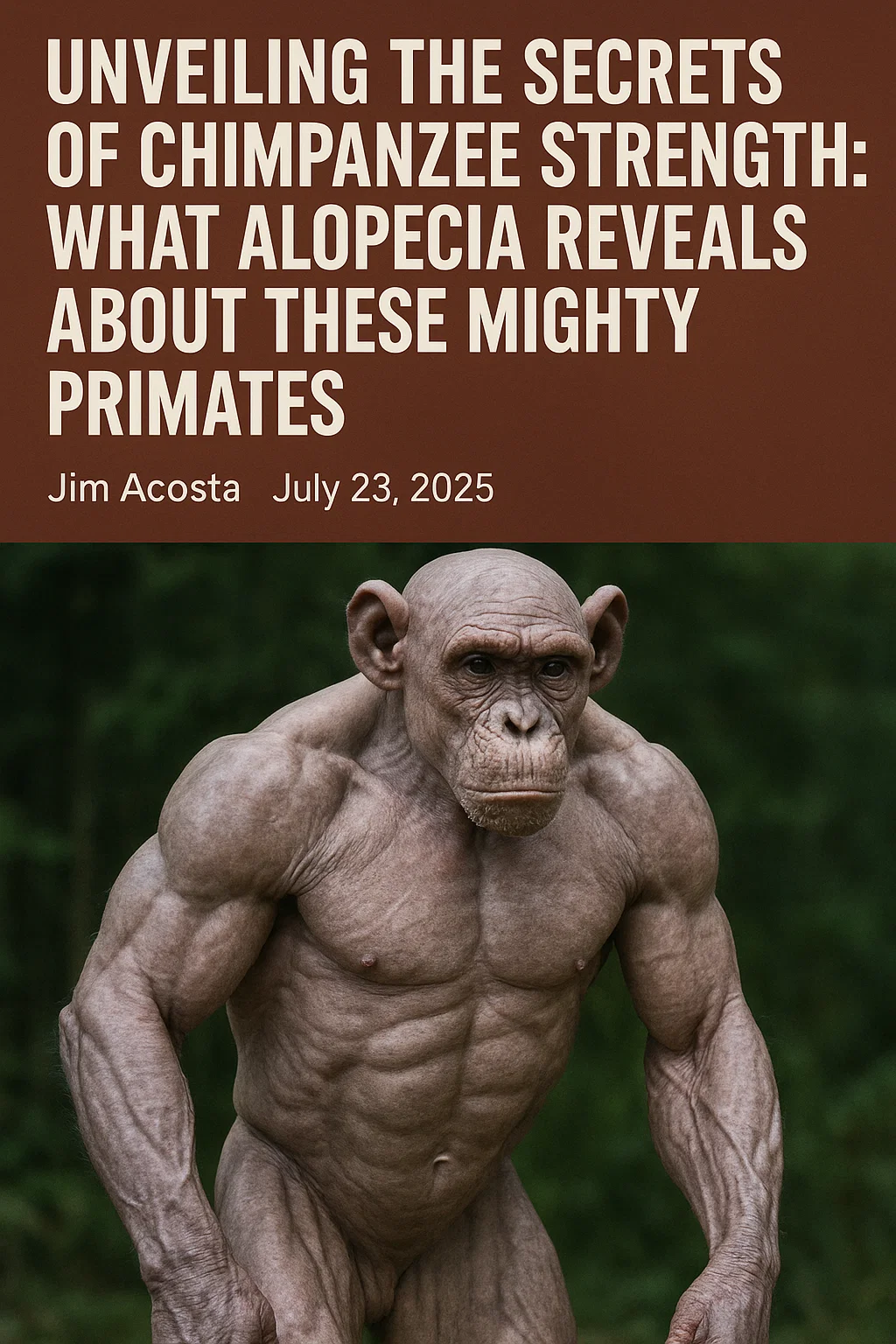
Have you ever heard of alopecia? It’s a condition where hair loss occurs due to various reasons. Now, imagine a chimpanzee with alopecia. Surprisingly, what may initially seem like a sad loss of hair, becomes a window into understanding one of nature’s most intriguing species. I recently stumbled across an interesting Reddit post featuring a chimp with alopecia, showcasing its incredible muscular build. This got me searching for answers to understand just why these primates are so astonishingly strong.
Chimpanzees: More Than Just Hairy Humans
Let me start by painting a picture of just how strong chimps are. Pound for pound, these primates have been long believed to be a whopping 1.35 times more powerful than humans. It’s clear Jonathan, the chimp with alopecia, isn’t bench-pressing in the wild, so how do they develop such prowess? The secrets lie in their muscles and their way of life.
Chimpanzees are native to Africa, and their genetic closeness to us—98.8% of our DNA is similar—sometimes makes us see them as just hairier versions of ourselves. But beneath that thick coat of fur lies a musculature that’s finely tuned for their arboreal lifestyle. Chimps live in trees, and their day-to-day activities involve swinging, climbing, and using their arms in ways we don’t typically need to anymore. This continuous forging of their natural gym results in a different muscle fiber composition compared to humans.
Muscle Composition: The Powerhouse of a Chimp Body
Research reveals that chimpanzee muscles contain more fast-twitch fibers than humans. These fibers are great for short bursts of explosive strength—the kind you need when leaping from branch to branch. In contrast, humans have evolved to have more endurance-based muscle fibers, which suit our need to walk or run long distances.
Besides, chimps also have longer muscle fibers than humans, which enhances their power output. Let’s say a chimp decides to shake your hand. What might feel like a friendly gesture would involve strength equivalent to someone trying to grip an overripe watermelon too tightly—once you grasp the difference in their muscle structure, you see why.
Evolutionary Pathways: A Tale of Adaptation
Humans and chimps share a common ancestor that roamed the earth somewhere between four to six million years ago. As we each evolved, our paths diverged. Humans adapted to bipedal life on open savannahs, developing endurance and long-distance running as survival strategies. Chimps, on the other hand, stayed in the rainforests, evolving bodies that excel in climbing and foraging in treetops.
This adaptation didn’t just change muscles; it altered their entire physique. The absence of a tail, longer arms compared to their legs, and a more robust shoulder girdle all contribute to their superior upper body strength. This evolutionary blueprint primes chimps for strength, much like our bodies have adapted for endurance and agility.
Chimps in Research: What We’ve Learnt
The interest in chimpanzees extends beyond strength. They’ve played a crucial role in scientific research, shedding light on our own evolution, social behaviors, and language development. While ethical considerations have shifted the usage of chimps in research, what’s learned remains invaluable.
But perhaps the most poignant takeaway from Jonathan and his alopecia is the reminder of the physical realities behind appearances. Witnessing his hairless form doesn’t just uncover musculature; it peels away superficial perceptions we might have about these primates and underscores their raw, natural power.
Lessons for Humans: Embracing Our Own Strengths
While we won’t be climbing trees like our chimpanzee cousins anytime soon, understanding this incredible strength gives us insight into our unique evolutionary journey. It’s a reminder that every creature, humans included, is perfectly adapted to thrive in its environment.
So, next time you find yourself at the gym staring down the pull-up bar, remember the chimps swinging through the forest, and take a moment to appreciate the different kinds of strength evolution has blessed each of us with. Who knows, maybe Jonathan’s alopecia wasn’t just an accident, but nature’s way of showing us what truly lies beneath.
About the Author