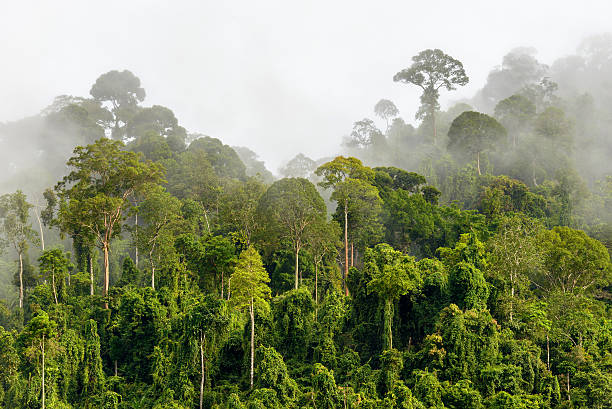
Treetops of Dense Tropical Rainforest With Morning Fog Located Near The Malaysia-Kalimantan Border
A hush falls over the jungle at dawn. Sawdust light spills through grease-slicked palms and wades in around a weathered outrigger at the river’s muddy edge. The air smells of damp leaves and diesel; a lone waterbird’s cry cuts the mist. In moments like this, long-buried secrets seem almost audible – faint gloaming echoing a story whispered since 1961.
Even here in Neotropical silence, the line between history and myth can blur. I think of the young Rockefeller heir lost in these very marshes more than sixty years ago. Watching that morning fog, it’s easy to imagine drama unfolding – a lost explorer shuffling among tribes named in legend – or at least, that’s how the rumor goes these days.
A Mysterious Disappearance
In November 1961, 23-year-old Michael Clark Rockefeller – son of then-New York Governor Nelson Rockefeller – set out to collect indigenous art in southwestern New Guinea. He and Dutch anthropologist René Wassing loaded a small homemade catamaran with woven gifts to barter. As a public-radio account notes, Rockefeller vanished “in a remote coastal area … inhabited by tribes known to engage in headhunting and cannibalism” (thisisfreshair.org). Late on November 17, their boat was swamped on the Betsj River. The two Asmat teenagers aboard swam away for help, Wassing – who couldn’t swim – was rescued, but Michael disappeared into the mangrove night.
For weeks authorities searched, finding only one flaming leg or two of the catamaran. No body, no definitive trace. The official presumption was that Rockefeller drowned. Even President Kennedy reportedly sent divers, hoping for a miracle. But local lore swelled almost immediately: might he have reached shore and met a far stranger fate? The Asmat people, after all, had only begun contact in the 1950s, and outsiders—Westerners—remained objects of fear and misunderstanding (thisisfreshair.org).
Tribal Lore and Early Clues
As rumors took shape, some villagers’ stories seeped into the record. Decades later, researchers found that a Dutch missionary had questioned Asmat elders in December 1961. They said that at dawn on November 20th, 50 men from nearby Otsjanep paused by the river. “Something moved in the water,” a modern retelling notes – first thought to be a crocodile, but then revealed to be “a tuan, a white man.” One Asmat reportedly shouted, “People of Otsjanep, you’re always talking about headhunting tuans. Well, here’s your chance.” Accounts say they speared the man and carried him into a creek, where they killed him and built a fire (www.smithsonianmag.com).
If true, that would be Rockefeller – but two curious details cast doubt. First, villagers told the priest they yelled about killing a tuan, not an expert like Rockefeller – someone “normal” who didn’t belong. Second, they described the victim wearing short trousers the Asmat had never seen (“shorts that ended high up on his legs” with no pockets) and no glasses (www.smithsonianmag.com). Rockefeller had been known to wear glasses, and casual shorts of that style weren’t in his gear. So historians point out a possible mix-up: the tribe may have killed some other lost traveler, then later the story slotted onto Rockefeller’s fate. Carl Hoffman, the author of Savage Harvest, frankly admits he never found a smoking gun (thisisfreshair.org). “I believes [it] is now clear,” he said in 2014, meaning he thought Rockefeller was eaten by villagers (his book even uses that phrasing (thisisfreshair.org)), but Hoffman also noted he was piecing together decades-old recollections. Memory can play tricks – for all we know, the tale could have grown in the telling.
Viral Rumors and the Tribal Photo
Enter the internet. Earlier this year a grainy photo began surfacing on social media: a shirtless white man grins among a circle of traditionally clothed Asmat men. The caption suggested this was Michael Rockefeller, secretly living with the tribe. Cue conspiracy bells. Nearly overnight, blogs and fringe forums lit up with speculation: had he really survived and adapted to a remote village for decades? Was this the “lost” heir come home?
I rolled my eyes. Images like this circulate all the time – photo legends without a shred of provenance. One friend joked it was straight out of a Scooby-Doo tropical episode (yes, that’s a pop-culture reference, but it fits a bit). The reality is likely more complicated. Those quick to believe it pointed to that Smithsonian story and said, “See, even the villagers described a white man. He had to be alive!” Yet seasoned scholars urge caution.
“Honestly, it looks like just another internet myth,” says Dr. Sarah Hocking, 58, a cultural anthropologist who has worked in Papua. She adjusts her reading glasses and adds, “I mean, people love this mystery, but we have nothing concrete. That photo? It was actually misidentified years ago.” She shrugs, informal. “I was right there by the river; I’ve seen old expedition shots. This one’s not him.” Hocking’s tone is flat but also amused; she’s heard these claims before.
“Folks will latch onto any image,” agrees Prof. Mark Willoughby, 65, a Pacific history scholar, tapping a pencil on the desk. He goes on, voice measured: “It’s gotta be said, it’s improbable. The timeline doesn’t fit. Rockefeller would be in his eighties now – not the youth in that photo. And the Asmat in modern photos sometimes have Western traders or missionaries among them, not because they were famous tourists.” He chuckles softly. “We learned long ago not to treat every canyon-town caricature as solid evidence.”
The Lingering Mystery
So what to make of all this? On one hand, the photo and myth remind us how stories survive. In Search Of…, a 1970s TV show hosted by Leonard Nimoy, even ran an episode about Rockefeller (www.richlandsource.com). The tale has a cinematic pull: rich boy among headhunters, the ultimate “what-if?” fantasy. People of a certain age (like me) grew up hearing it on late-night folklore segments. On the other hand, every serious investigation so far has turned up nothing new. Searchers found no personal items, no bones, no credible sighting reports beyond the murky account with the priest.
What’s undeniable is that the internet amplifies curiosity and mistrust. A recent Pew study notes that younger people are especially skeptical of viral claims – and yes, I’ve seen savvy young readers debunk this one, too. Still, even old skeptics can have a twinge of wonder (I won’t deny I felt a shiver seeing that image at midnight). In the end, doubt is healthy. After all, there’s a reason “the reality is likely more complicated.”
For now, Michael Rockefeller’s fate remains one of history’s alluring riddles. The photo doesn’t settle anything; it only stirs the pot. As one sawdust-bearded elder in the archives paraphrased it: “The jungle gives up its secrets on its own timetable.” That clock hasn’t struck yet.
Throughout this strange case, the one clear lesson is when to hold skepticism. Object lessons pour from that cloudy image: check the dates, question the source, and remember we live in a time when anything can trend fake. As I close this chapter (coffee rings on my notebook and all), I’m reminded of how these tales cast long shadows on the water. Ultimately, maybe the lesson is simple: sometimes mysteries stay mysteries – and that’s okay.
About the Author