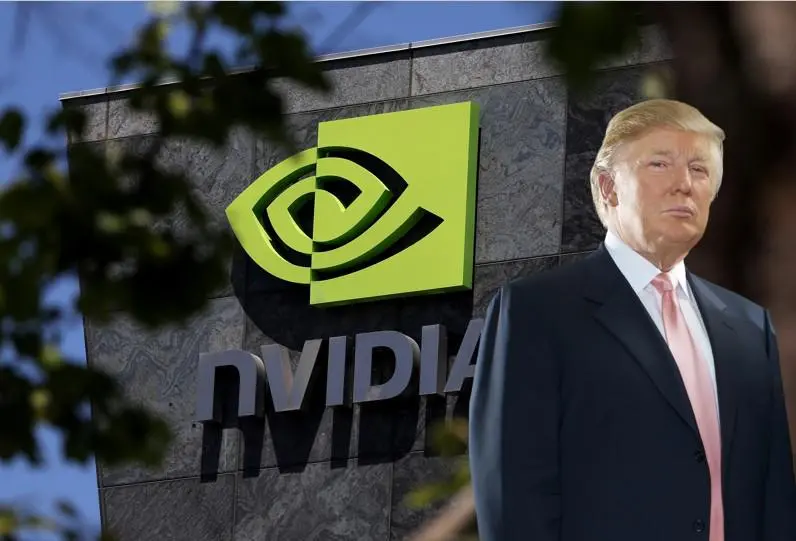
So, picture this: It’s another day in the world of tech and politics when an unexpected plot twist unfolds. Former President Donald Trump, amidst various regulatory discussions, apparently threatened to break up Nvidia—a company he hadn’t heard of before. Let that sink in. It’s a “what the heck” moment, right?
Who’s This Nvidia Anyway?
Let’s break this down a bit for the uninitiated (and perhaps for Trump as well). Nvidia is a heavyweight in the tech industry, known for its graphics processing units (GPUs) that power everything from video games to artificial intelligence. Founded in 1993 by Jensen Huang, Nvidia has transformed from a modest chip designer into a global tech leader, shaping industries and pushing the limits of what’s technologically possible.
The Curious Case of Presidential Attention
The Reddit post suggests Trump didn’t know Nvidia, which is curious but understandable to some extent, considering the broad array of topics a president deals with. But it raises an interesting question: Why would Trump consider breaking up Nvidia?
Well, the context is likely rooted in the broader debate over the power of tech giants. Previously, Trump’s administration took tough stances, particularly with companies involved with China or seen as monopolizing various tech segments. Nvidia’s significant role in AI and gaming certainly puts it on the radar.
Why Does Nvidia Matter?
Here’s the thing—Nvidia isn’t just another Silicon Valley success story. It’s a central player in the sectors driving the future: AI, machine learning, and data centers. Their GPUs are like the brains behind complex computing tasks. Whether you’re watching a cutting-edge CGI movie or a company’s training neural networks, Nvidia’s technology might be at work.
And while Trump may not have known Nvidia, experts and industry watchers certainly do. For example, according to Jon Peddie Research, Nvidia holds a substantial market share in the discrete GPU market, with their prowess extending into autonomous vehicles and cloud computing.
When Politics Meets Silicon Valley
This situation reflects a broader trend: the intersection of politics and technology. Politicians have often struggled to keep up with tech’s rapid pace. Whether it’s Facebook managing content or Google working through antitrust issues, the regulatory environment is critical—and often contentious.
But Trump’s remark adds a twist. It exemplifies how even those with clout can be out of sync with the tech ecosystem’s intricacies. It’s a reminder of the divide between policymakers and the software or hardware they’re poised to regulate.
The Ripple Effects of Breaking Up Nvidia
Hypothetically speaking, what if Nvidia were broken up? The implications could be enormous. The tech industry is deeply interconnected. From semiconductor supply chains to partnerships in autonomous driving with firms like Tesla, Nvidia’s reach is expansive. A breakup could unsettle industry equilibrium and innovation pace, affecting not only tech companies but consumers and economies globally.
Yet, historical precedents show that breakups sometimes bolster innovation. Take the AT&T split in the 1980s: it spurred competition and technological advancement. Could the same happen with Nvidia?
In Conclusion: A Lesson in Bridging Worlds
While Trump’s comment was a momentary blip, it highlights a critical issue: the need for understanding and dialogue between tech firms and regulators. For those in power, staying informed about key players in industry and their roles is essential.
For Nvidia, it underscores their significance in today’s tech-enabled world. For us, it’s a humorous yet telling reminder of how easily technology can slip from the gaze of even the most informed. So next time you boot up a video game or use an AI-driven app, remember the subtle might behind the name Nvidia—whether the White House knows it or not.
In any case, let’s hope that bridge between politics and tech keeps strengthening. Because let’s face it—the future depends on it.
That’s the scoop. What do you think? Is it a reminder that our world leaders need a tech crash course, or is it just one of the many quirks in the ongoing story of politics and technology? Let’s continue the chat in the comments below!
About the Author