Rain tapped the newsroom window; the faint scent of burnt coffee and a single coffee ring on my notebook lingered as the printer hummed. A worn leather watch strap lay near the margin, a small, ordinary anchor.
That morning hum made the cosmos feel oddly near. You lean out the window, squint at a restless sky, and wonder: if every bit of mass pulls on every other, why aren’t we all part of one gargantuan rock? It’s the kind of question a kid asks on a road trip—mine asked it in the back of a Chevy station wagon while we watched a meteor trace a thin white scratch across the black. That image stuck with me (and yes, I referenced an old Twilight Zone line to embarrass my son).
How gravity behaves — and why it doesn’t simply glue everything together — is messy and counterintuitive. It involves scales from quantum quirks to cosmic expansion, and a few pieces of physics that refuse to play along.
Gravity is long-range, but weak
Isaac Newton’s simple law — force falling off as the square of distance — makes gravity universal. Every mass tugs on every other mass. But tugging is not the same as dragging. Gravity is extremely weak compared with the electromagnetic force that binds atoms and molecules. The electrons that keep two atoms from passing through each other are held by forces many orders of magnitude stronger than the feeblest gravitational pull between those same atoms.
Dr. Maya Singh, 43, an astrophysicist who studies star formation, puts it plainly: “Gravity’s patient. It’ll win if you give it enough time and mass — but in the meantime, there’s temperature, pressure, and chemistry getting in the way. I mean, you can’t just squish an atom by shouting at it.” Her laugh, then a small pause: “We tell students that; they look at you like you’re messing with them.”
Pressure and motion push back
As clouds of gas try to collapse under self-gravity, thermal motion — atoms and molecules jittering from heat — generates pressure that counters the pull inward. Stars form when gravity overcomes that pressure locally, but only after gas cools or is compressed by shocks. When collapse continues, quantum mechanics eventually intervenes: electrons refuse to be squeezed into the same state, creating degeneracy pressure that props up white dwarfs. Squeeze harder, and neutron degeneracy kicks in, holding up neutron stars. Push beyond those limits and a black hole may form.
This succession of resistances means that parts of the universe do collapse into compact objects: planets, stars, and black holes. That’s why we have the familiar clumps of matter rather than one continuous lump.
Angular momentum, tides, and messy collisions
Material falling inward usually carries angular momentum. Think of ice skaters pulling in their arms to spin faster — the math is the same. Rotating gas clouds flatten into disks, limiting direct radial collapse and encouraging the formation of swirls and rings instead of a single ball. Galaxies merge, but their stars mostly pass by each other; collisions are messy, not instantaneous merging. Over cosmic time, structures grow hierarchically: small clumps become bigger ones, and clusters of galaxies form, not one universe-wide solid.
A retired teacher named Tom Reyes, 67, who once ran a stargazing club, remembers his students’ surprise. “They figure gravity’s this big magnet and everything should just come together — gotta say, that was my knee-jerk, too, when I was younger. Then you show them maps of galaxy filaments and voids and they go, ‘Oh.’”
Expansion and the large-scale picture
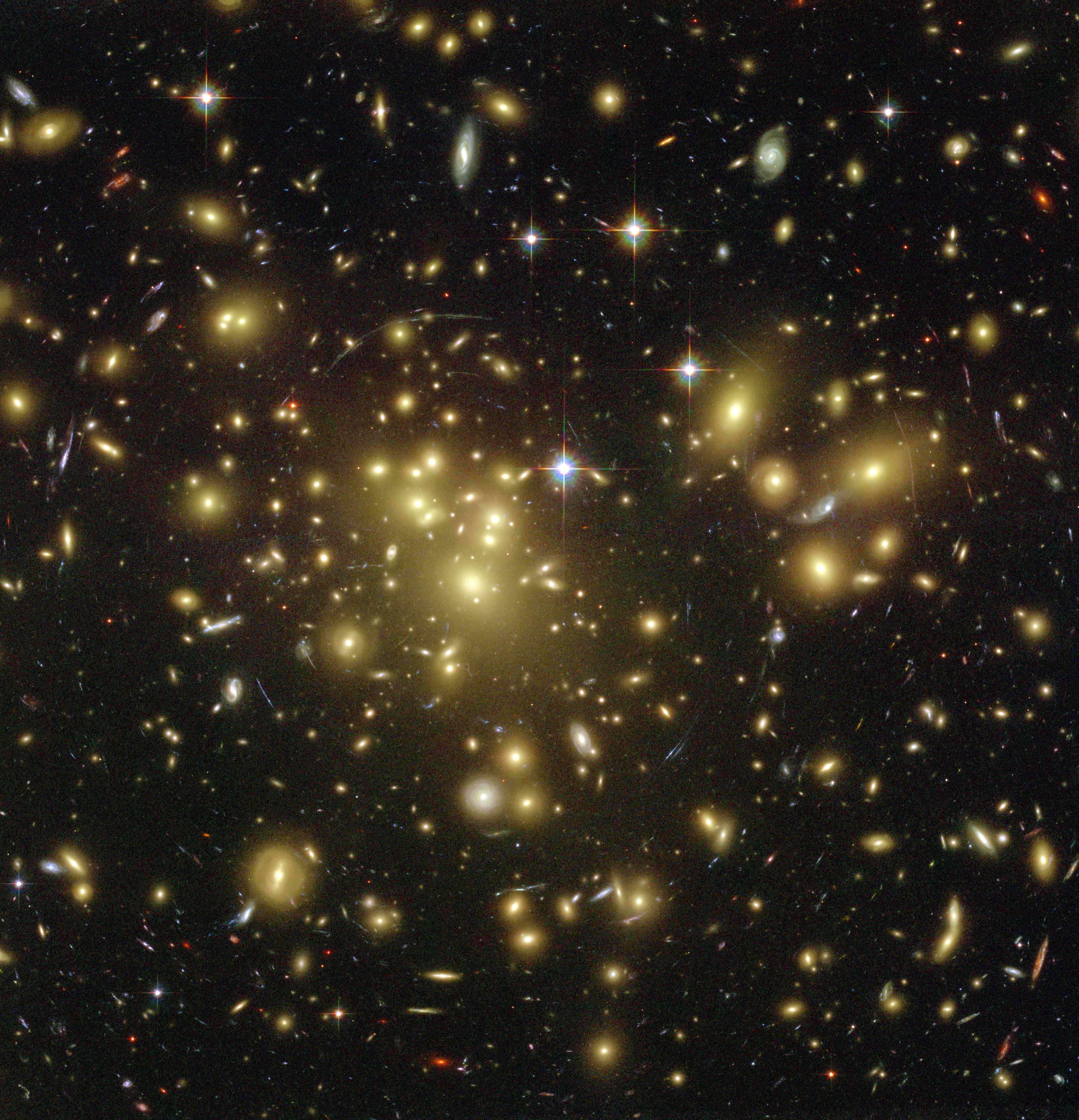
On the grandest scales, space itself is stretching. After the Big Bang, initial overdensities grew into the cosmic web of filaments and voids we map today. But cosmic expansion — and the phenomenon labeled dark energy that speeds it up — affects whether distant regions can ever come together. Clusters gravitationally bind locally, yes; the overall expansion makes it increasingly unlikely for far-flung galaxies to meet up. Reuters has carried features about dark energy’s accelerating role, noting how the universe’s late-time behavior favors separation over global reunification.
So you have gravity pulling, messy local physics resisting, and expansion widening the gaps. The result: islands of matter in a sea of growing space.
Why scale matters
The inverse-square law means a star next door tugs far more strongly on you than a whole galaxy at a hundred million light-years, even though the galaxy has vastly more mass. That’s because those far masses are also very far. Local conditions dominate. What binds your coffee cup to your desk isn’t the gravity of distant clusters; it’s electromagnetic forces between atoms and the desk’s structural strength.
Snopes has run through viral claims that idealized gravity should make everything clump, pointing out that everyday intuition skips over these scale-dependent forces and energy balances. Which, honestly, is an easy trap to fall into when conversations drift from backyard telescopes to headline-grabbing cosmology.
Where things are still fuzzy
There’s an open question about the exact distribution and nature of dark matter and how that shaped structure formation early on; sources remain conflicted about specific models. We know dark matter helps glue galaxies together, but its microphysics — what, exactly, it is — remains a live mystery. That uncertainty colors our understanding of why some regions collapsed more than others.
A small digression: the physics feels a bit like baking. You can toss ingredients together, but whether you get a single brick of cake or a bowl of crumbs depends on temperature, mixing, and timing. The analogy breaks down quickly, but it helps on a rainy afternoon.
Consequences and everyday relevance
Understanding these balances matters beyond curiosity. It shapes where planets form, whether systems are stable, and how galaxies evolve. It also influences science communication. Viral posts claiming the universe should be one lump mislead more than they enlighten; they skip the intervening layers of thermal physics, quantum mechanics, and cosmic expansion.
I remember asking a barber this question once, while he trimmed around my ears. He shrugged, left-handed with a small silver ring on his pinky, and said, “If everything stuck together, there’d be no room to stand.” That bluntness stuck with me, simple and true.
A final note (brief): You can boil the answer down, but you’ll miss the texture. Gravity matters. So do resistance, motion, and stretching space. The universe, in other words, is complicated — and a little stubborn.
Author’s reflection
As a journalist who’s spent nights on rooftops watching satellites blink past, the question keeps me humble. Science offers tidy laws and messy reality; both are essential. I still like that station-wagon meteor memory. It’s a small thing, but it reminds me why we ask such big questions in the first place.
About the Author