Rain tapped the windowpane; the faint scent of antiseptic lingered. A leather notebook lay open, a coffee ring bloomed at the corner, and outside the buzz of distant lawnmowers sounded almost like background static.
We tell ourselves bodies are machines of renewal: skin flakes off, liver regenerates, the gut replaces cells by the million each day. That comforting image—of a body that constantly remakes itself—prompts a stubborn question: if most cells are replaced, why do scars persist, sometimes for life?
The biology beneath the skin
Wounds are solved first with urgency, not artistry. When skin is cut or burned, the body summons clotting factors, immune cells, and fibroblasts to seal the breach and stop infection. Those fibroblasts lay down collagen and other structural molecules to build a patch. This patch becomes the extracellular matrix (ECM), a three-dimensional scaffold of protein fibers that gives healed tissue its strength.
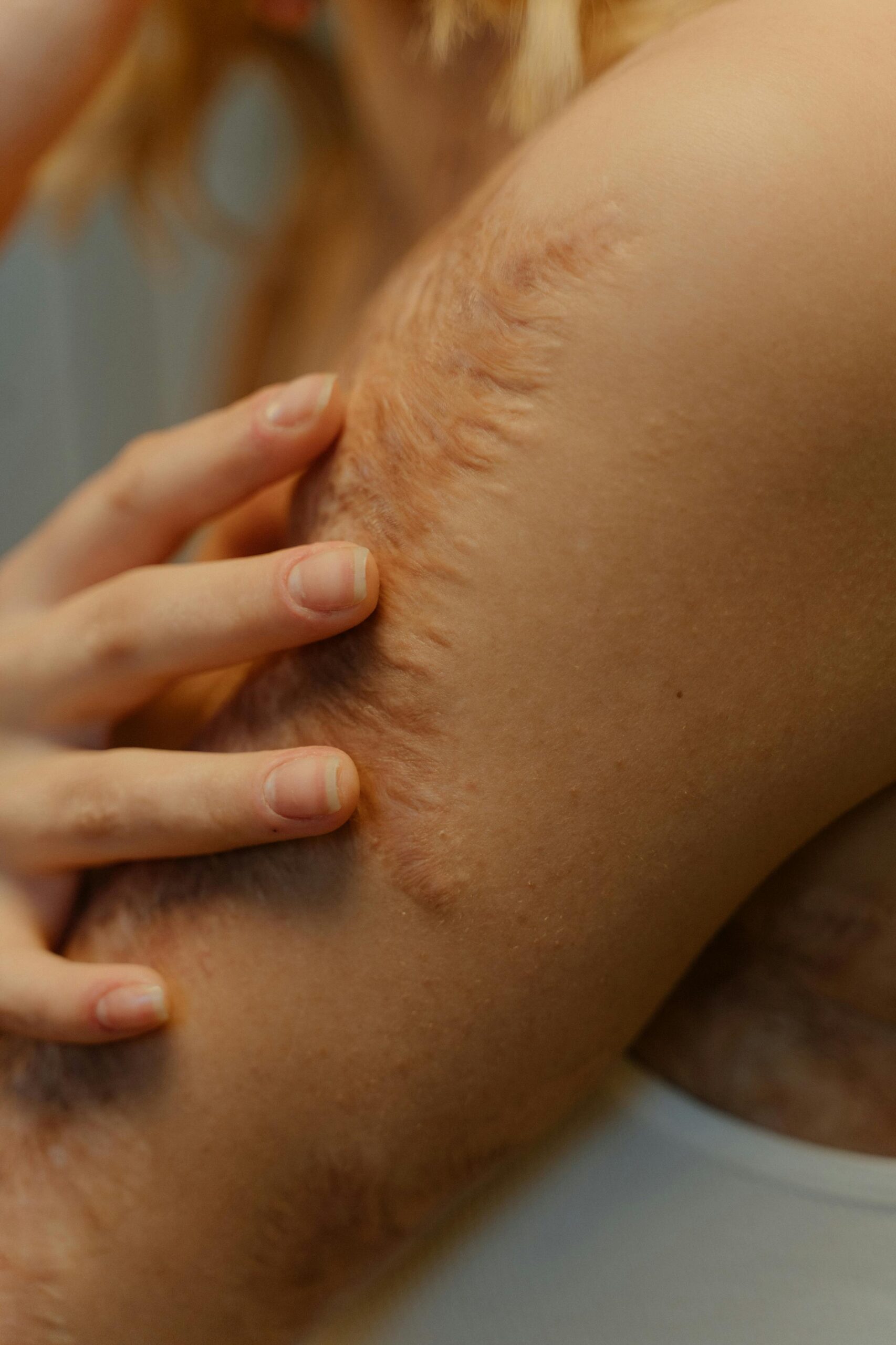
Collagen matters most. The collagen laid down during healing is arranged quickly and densely, with fibers that run parallel rather than in the basket-weave pattern of uninjured skin. Those fibers are chemically cross-linked and can persist for years, anchoring the scar’s shape even as the cells embedded in and on it cycle out. Short version: the cells change, but the scaffold often does not. So scars keep their silhouette.
Why scars endure
Not all tissues regenerate the same way. The lining of the intestine renews constantly because it has a built-in stem-cell niche tuned for turnover. Skin has stem cells too, but they are specialized to replenish the epidermis, not to reconstruct complex appendages—hair follicles, sweat glands—or to reorganize a disordered ECM back into the original architecture.
Myofibroblasts, a kind of contractile cell, are part healing team and part builder. They pull wound edges closed and make collagen, then some stick around long enough to remodel the scar. But once that collagen scaffold forms, it can be stubborn. Enzymes that break it down—matrix metalloproteinases—exist, yet their activity is tightly controlled. In some scars, the balance tilts toward permanence.
Dr. Maya Singh, 48, a dermatologic surgeon and clinical researcher in Boston, says, “People imagine skin as a conveyor belt—out with the old, in with the new. It’s not that neat. You get new cells riding on old scaffolding. The architecture stays.” She pauses, then adds, “I gotta say, patients are surprised when I tell them the scar is more than skin—it’s a little building that didn’t get redecorated.”
A widespread myth quietly persists: that skin completely renews every seven years. Snopes has long unpicked that tidy number, and investigative pieces in outlets like Reuters have pointed out that turnover rates vary wildly by cell type and tissue. Collagen fibers, unlike the surface cells that flake away, can last for years or decades.
When healing misses the mark
Scars come in flavors. Hypertrophic scars are raised but stay within the wound’s borders; keloids spill over into surrounding skin. Some of that difference is genetic—populations and families show different propensities—and some is mechanical: tension on a wound influences how collagen is laid down.
There’s one fascinating exception that scientists use as a clue: fetal wounds. Early in development, human fetuses can repair skin without scarring, restoring normal architecture. That scarless healing has become a research lodestar—if we could mimic the fetal environment, perhaps adult healing could be gentler. The reality is likely more complicated. Immune signaling, cellular behavior, and growth-factor profiles all differ in the womb.
Treatments, experiments, and uncertainty
Doctors offer remedies that help appearance and function: silicone sheeting, steroid injections, laser therapy, surgical revision. Newer approaches aim upstream—modifying cellular signaling, using stem cells, or targeting the ECM with enzymes. The National Institutes of Health houses multiple studies exploring these paths, but a complete, routine reversal of scars remains out of reach.
“Some treatments soften things, sure,” says Maria Lopez, 34, who runs a small tailoring shop and carries a long burn scar along her forearm. She shows me a faded denim patch on the pocket of her favorite jeans—a habit of mending that has outlived many shirts. “It never fully went away. I learned to tuck my sleeve, wear a bracelet. You learn to live with it, you know?” She shrugs. “But the first summer after it happened—man, I felt like everyone was staring.”
Research trends are promising but noisy. Reports in mainstream press and specialist journals have described promising animal or small clinical trials. Reuters has highlighted a handful of biotech startups chasing scar-modifying drugs. Some approaches target fibroblast behavior; others attempt to remodel collagen directly. Sources remain conflicted on which strategy will scale safely and affordably.
A short aside: scars as stories
Humans have long treated scars as narrative. Tribal scarification, wartime marks, ceremonial cicatrices—they turn injury into identity. I once interviewed a Vietnam vet who tapped a raised line on his forearm and said, “This is my map,” then laughed and reached for his cigarette (yes, cigarettes—an old habit from a different reporting era). That little detour reminded me that science sits alongside culture; you can’t separate tissue from testimony.
An open question—and what it means
We can state this with confidence: cells turn over; collagen and ECM can persist. We can also say frankly that the field doesn’t yet fully understand how to make an adult wound remodel back to pre-injury architecture reliably. It remains unclear whether a single intervention will do the trick or whether combinations—timed precisely—are needed.
For readers wondering what that implies practically: take wound care seriously early—clean wounds, seek timely medical attention, and follow post-op advice. Early intervention can shape how collagen is laid down. For policy and health systems, the long-term implications are worth watching: therapies that reduce scarring could lower chronic pain, improve mobility, and affect mental-health outcomes. Pew Research has shown that health innovations often shift public expectations; if scar-reducing treatments become common, people may demand access, raising questions about cost and equity.
A brief personal note
I once sliced my thumb while hurriedly opening an envelope—no drama, just a neat white line that bothered me when I typed. Years later it’s still there. I keep a worn golf glove in my desk drawer (odd detail, I know), and sometimes I touch the pad where the leather is thinnest. A scar is, I suppose, both nuisance and memory. That thought has stuck with me through research and interviews.
So scars stay.
They remind us that bodies are both dynamic and historical. They repair fast when safety matters, and they accept imperfect fixes. Science chases a way back to seamless skin. For now, scars remain part biology, part biography.
About the Author